A verifiable system foundation
Reproducible behaviour, replay and the audit trail help establish how the Core reached a result. The local test summary shows which capabilities were tested and under what conditions.
Hydra is a modular observation and decision-support platform in development. Its strength is governance: verification and authorisation rules enforced in a shared Core, with deterministic, fail-closed behaviour. Its first interface in development supports the review of financial data and observation status.

A shared platform with focused modules.
Verified steps and traceable results.
Planned assistance with analysis and optimisation, under human control.
01 / PROJECT STRENGTHS
Governance is a central strength of Hydra: it defines the conditions for authorising an operation, a module’s scope of authority and the evidence required for verification. Modular development aims to let new applications build on this shared system foundation.
Reproducible behaviour, replay and the audit trail help establish how the Core reached a result. The local test summary shows which capabilities were tested and under what conditions.
New applications can build on the fixed system baseline. The modular direction aims to reuse existing Core capabilities while each new module receives separate development and verification. Shared requirements and reusable Core capabilities may reduce the number of solutions that need to be developed separately for each module, simplifying integration and operations.
Governance brings together authorisation conditions, module authority boundaries and required evidence. A governing principle is that a technical STOP can close only after the required correction, evidence and prescribed separate review. AI is planned as optional, replaceable support without independent decision authority.
STRENGTHS OF HYDRA CORE
Hydra Core is a completed, frozen system baseline. These capabilities apply to the Core; full verification and the 1.0 completion of the first UI module are still ahead.
The same inputs, fixed system version and operating conditions produce the same result. This makes behaviour easier to verify and differences easier to investigate.
If a required check is not satisfied or evidence needed for authorisation is missing, the affected operation remains blocked. Uncertainty does not automatically become permission.
Recorded events allow behaviour to be replayed and verified. The audit log helps establish which steps led to the result.
The local test output supplied by the operator reports PASS for all six selected Core test groups.
| Capability tested | Result |
|---|---|
| Freeze characterisationChecks of the tested decision and fail-closed behaviour conditions. | PASS · Successful4/4 |
| Deterministic behaviourReproducible audit output on both execution paths. | PASS · Successful3/3 |
| Execution-path correspondenceChecks of the named outcomes, invalid inputs and path independence. | PASS · Successful |
| Deterministic replayReplay of recorded event history with identical results. | PASS · Successful |
| Audit streamChecks of event ordering, appending and immutability. | PASS · Successful |
| Audit-chain integrityDetection of field mutation, insertion, removal and reordering. | PASS · Successful |
The deterministic comparison used a fixed clock and deterministic ID generation, excluding fields that measure execution duration.
The results apply to the tested Core capabilities and conditions. Full verification of the first UI module is a separate development task.
A CONCRETE ENGINEERING RESULT
The local audit-chain test results show what integrity verification means in the examined cases.
Verification found the unchanged audit chain used as a reference valid.
The tests examined four kinds of change: field mutation, insertion, removal and reordering.
According to the reported test results, audit-chain verification detected all four examined changes.
Engineering value: Results from the covered test cases support detection of the examined data changes. This supports verification of the recorded history’s integrity and later auditing.
Scope: the Core’s local audit-chain test. Independent evidence against rewriting the complete history requires a protected external reference; that capability is not yet implemented.
This summary is based on commands and terminal output shared by the operator. The working directory’s package.json included a local E2E test extension; the six commands listed here also exist in the recorded Core version and did not invoke that extension.
This validation records the results of the selected local tests. Evidence for the full test suite, the separate CI run and freeze acceptance closure is separate. External anchoring of the audit chain is not yet implemented; the fail-closed and path-correspondence results apply to the named test cases.
WHAT IS BEHIND THE INTERFACE?
Hydra’s shared Core brings together operational control, repeatability and audit capabilities. Application modules can connect through separate development and verification.
Rules and authority boundaries frame operation. In the presented Core tests, guard decisions for invalid input returned HALT, meaning a stop.
Practical significance: a missing required check must not automatically become permission.
Across the two tested execution paths, audit output was repeatable with a fixed clock and ID generation, excluding duration fields.
Practical significance: differences can be investigated more precisely when starting conditions and the system version are fixed.
Replay tests examined replay from fixed event history and consistent event ordering. The tested shuffled input history produced an identical replay result.
Practical significance: recorded events can support later investigation and help isolate ordering differences.
The audit stream checks recording order and append rules; the audit chain checks how entries are linked. Local tests examined detection of several kinds of change.
Practical significance: integrity of the recorded history is a separate verification subject. External audit-chain anchoring is not yet implemented.
The presented evidence applies to the named Core tests. Full integration and operation of the first UI module require the module’s own verification.
Test conditions and resultsINTENDED USERS AND CONNECTIONS
The first UI module is being built for people who review and evaluate financial data. Further uses of the platform include module development, organisational applications and software connections.
Reviewing financial data, data sources and observation status to support their own assessment. The first UI module demonstrates this use case.
They can build modules for specific tasks on the shared system foundation, following the platform’s connection and verification rules. This could provide a basis for new application areas.
Over time, they could support their analytical or operational tasks with modules built on Hydra. A module suited to each task requires separate development and verification.
They can supply data to Hydra modules or connect to the platform for defined tasks. Each connection requires a separately developed and verified integration.
People generally use a module’s interface. Developers and connected software build on the platform’s capabilities. Financial observation is the first application; further uses will be shaped by subsequent development decisions.
02 / APPLICATIONS
The first module is being built to help users review financial data and its observation status. Research and operational applications are future directions to evaluate.
The interface in development aims to let users review financial observation data and its displayed status in one place. This provides a basis for their own assessment.
Before making an assessment, review what data is available and what observation status the interface shows.
Additional application areas are possible development directions. This presentation does not imply that finished modules or a trading service are available.
A CONCRETE USE EXAMPLE
Development images show two separate states: data presentation and a deliberate data connection error test. They make the developing module’s user goal tangible.
Finnhub is the data source used to develop and test the first version. The presented interface displays the source and observation timestamp alongside AAPL data, providing context for interpretation.
In the deliberately induced error, the interface shows a data request error and unconfirmed freshness. Connection status and data currency are separate information.
The goal is to let users assess data together with its status and recognise when fresh data or further verification is needed for their own conclusions.
03 / PROGRESS SO FAR
The project’s progress follows three stages: the Hydra Core baseline is complete, the first UI module is being built to demonstrate the system’s operation, and its completion will be followed by a market and user review.
The deterministic, fail-closed baseline of Hydra Core is complete and frozen: it provides a fixed system foundation for further module development.
The first UI module is being completed. It will be Hydra’s first module to demonstrate the system’s operation through a user interface, using the financial observation application.
After completion of the first UI module 1.0, a market and user review will inform the next roadmap. New modules and optional AI connections are possibilities to evaluate.
The results shown relate to development stages documented so far. They do not represent a complete product release or a performance guarantee for every environment.
The development captures show data presentation and a deliberate error test. The separately labelled concept image illustrates the planned appearance.
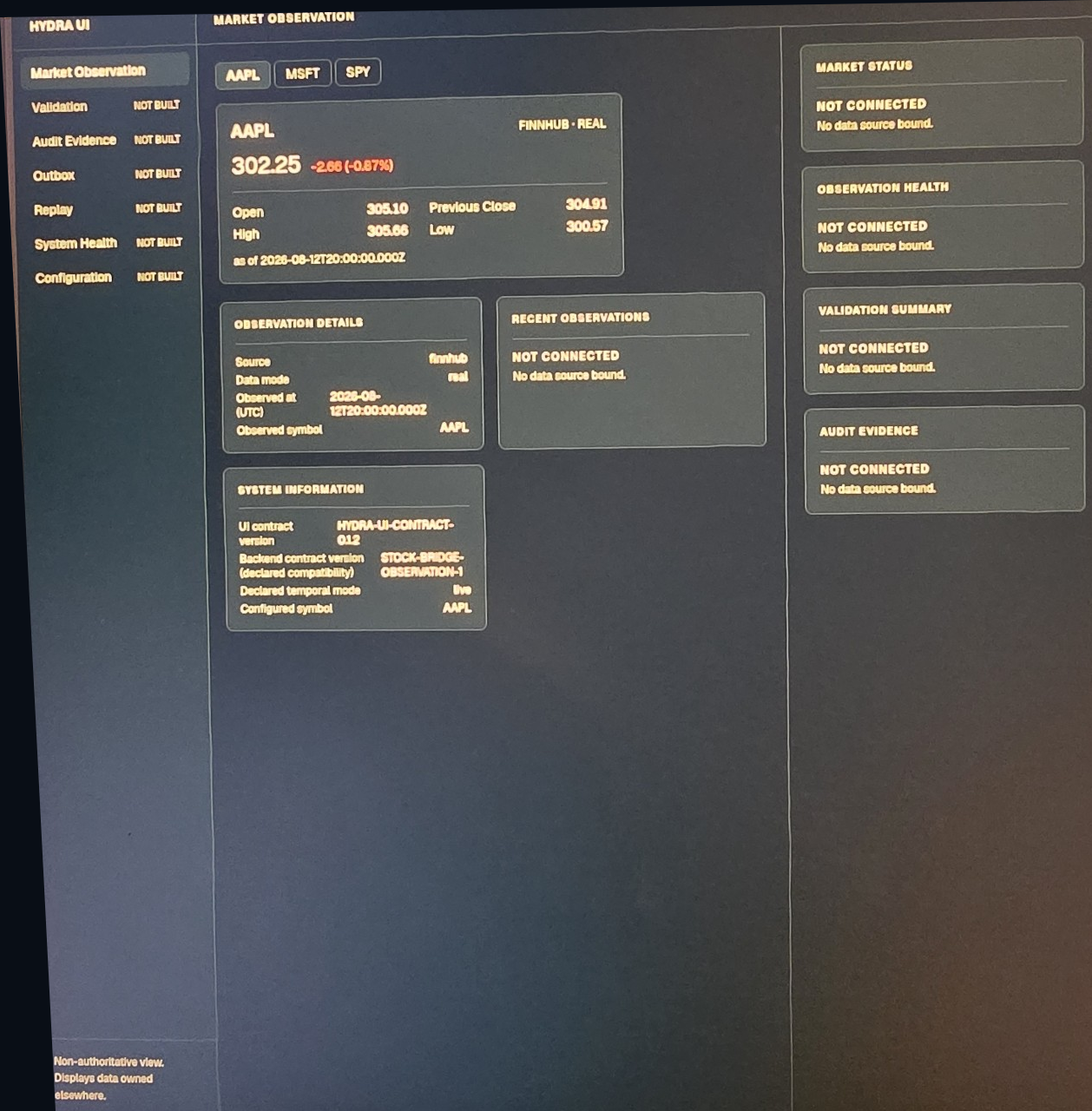
The capture shows AAPL financial data, the Finnhub source and the observation timestamp. Finnhub is the first version’s development and testing data source; the image illustrates the data display already implemented.
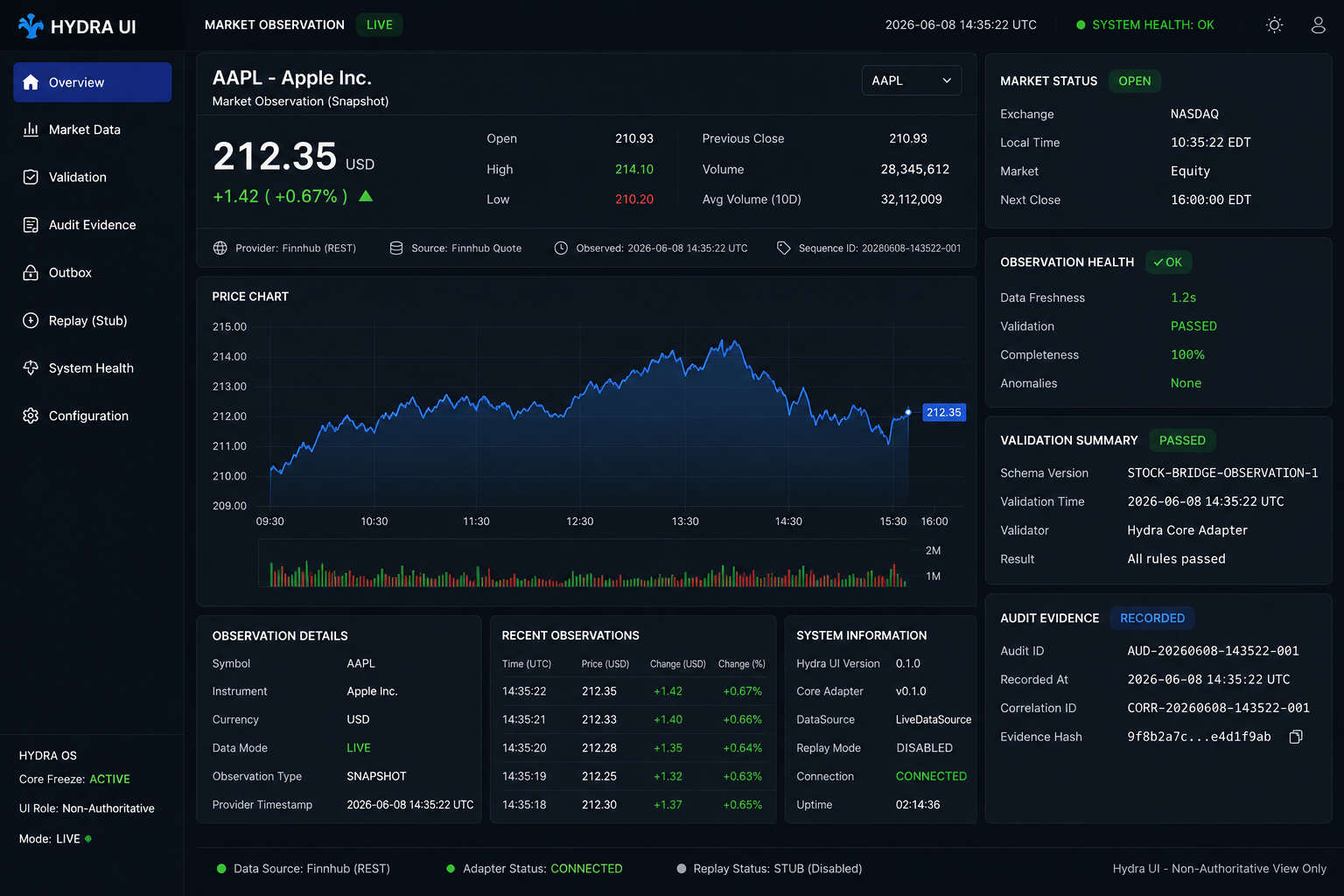
The concept image shows the planned layout of the financial observation interface: market data, a chart and status indicators. The goal is to make important information easier to understand.
The prices, successful checks and audit indicators shown are illustrative. They do not establish that these features are complete; implementation and verification remain part of further development.
Open image at full size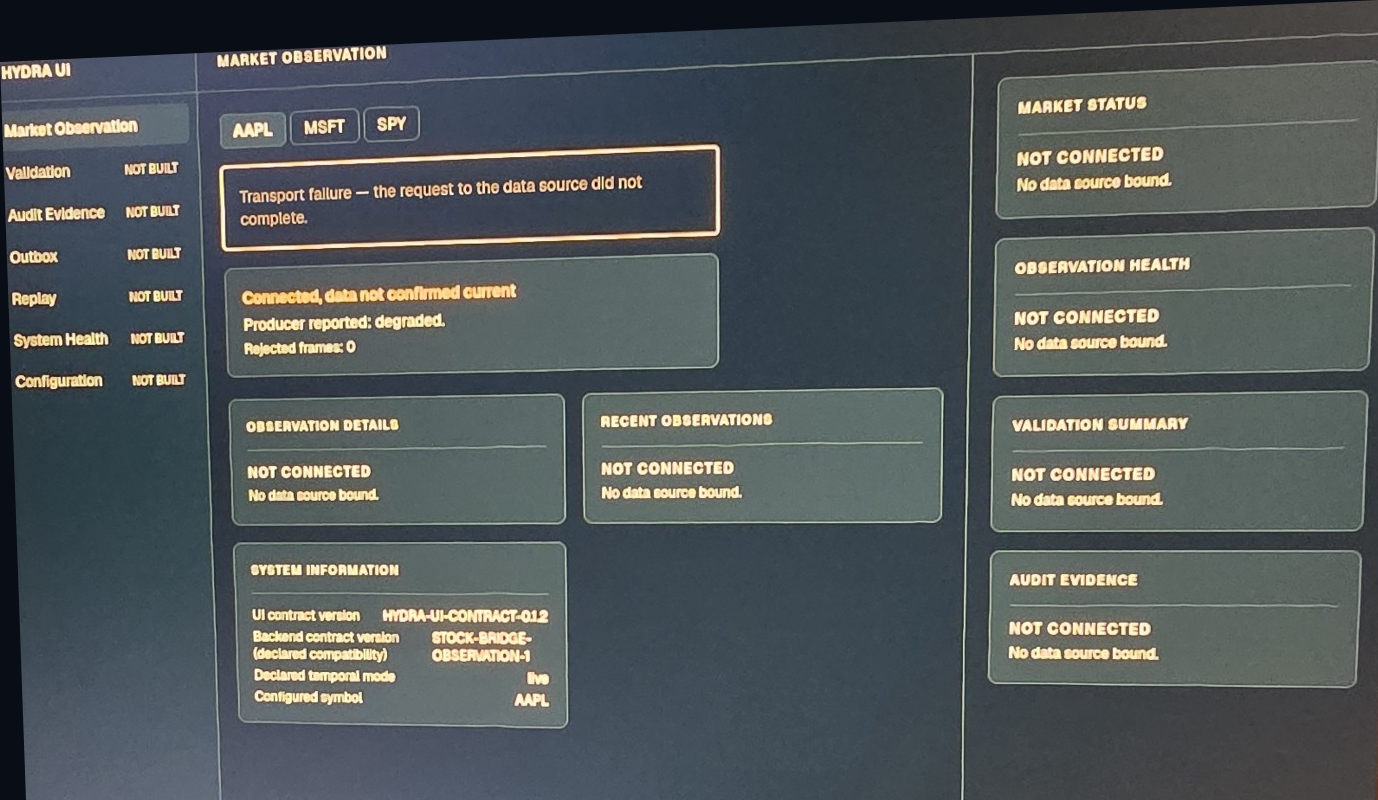
During development, a data connection error was deliberately induced to observe the interface response. The capture shows the data request error and a notice that data freshness is not confirmed.
Connection status and data freshness are separate pieces of information: the interface also indicates when data currency is not confirmed. The image shows the visible feedback for this test scenario.
Open image at full sizeEach capture records a particular development state. Completion and full verification of the first UI module 1.0 are still ahead.
AI WITHIN HYDRA
Hydra’s planned AI integrations could support analysis, performance evaluation and optimisation. The design principles require AI tools to be replaceable and the platform’s core functions to operate without AI.
04 / HYDRA’S EVOLUTION
Current development builds on earlier results. Choose a milestone to explore its outcome, significance and supporting evidence.
Now: development of the first UI module
The date refers to the named verification. Other entries represent development stages; testing and module development also run in parallel. Planned continuation uses a dashed line.
COMMON QUESTIONS
The Hydra Core baseline is complete and frozen. The first demonstration module, the UI, is being completed; the 1.0 milestone is still ahead. This module will demonstrate the system’s operation through a user interface. After completion, a market and user review will inform the next roadmap.
Financial observation is the first application area. Over time, the modular platform may support other analytical and operational tasks; selecting and implementing them is a future development decision.
People retain responsibility and make decisions. Planned AI support could assist analysis, performance evaluation and optimisation through optional, replaceable tools. It is a design principle that Hydra’s core functions operate without AI.
A result that has been examined and documented under specified conditions. The assessment applies to the capability and environment examined; it cannot automatically be extended to the entire product in development.
DEVELOPMENT SHOWCASES
Short, individually shareable showcases. Each explains what is shown and the scope of its evidence.
What does it add to interpretation when the data source and observation time are visible?
Open the showcase →A deliberate error test shows how uncertainty appears in the interface in development.
Open the showcase →A local test result that explains the engineering value and limits of checking an audit trail.
Open the showcase →CONTACT
Get in touch by email with user questions, professional collaboration opportunities or investment enquiries.
EARLY TESTING
Let us know if you would like to try the first demonstration module. When a testable version is available, we may contact you at the email address you provide.
UI 1.0 is still in development. Signing up expresses interest; access dates and participant selection are not yet determined.
Completion of the first UI module will be followed by a market and user review. Its findings will determine the direction of the next development period.